




- How Our Product Liability Attorneys Help You With Your Claim
- What Is Product Liability?
- What Is Considered a Defective Product in Nebraska?
- Proving Liability in a Defective Product Case
- Steps to Take After Suffering an Injury Due to a Defective Product in Omaha
- Compensation for Defective Product Claims in Nebraska
- Speak with an Omaha Product Liability Attorney
- Product Liability FAQ
Product manufacturers, designers, wholesalers, retailers, and anyone involved in the chain of commerce have a legal responsibility to ensure that their products – when used properly – do not harm consumers. Unfortunately, defective products still make their way into the Nebraska marketplace and can cause serious injuries with long-lasting consequences. Many people who are injured by a product believe the accident was their fault, when in reality the defect may have been entirely beyond their control.
That’s where our product liability attorneys come in. Hauptman, O’Brien, Wolf & Lathrop, LLC has been serving victims of defective product injuries in Omaha and throughout Nebraska for over 40 years. Our legal team investigates the cause of the defect, identifies every potentially liable party, and fights to recover the compensation our clients deserve for their medical expenses, lost income, pain and suffering, and other losses.
If you have been injured by a dangerous or defective product, call our Omaha product liability attorneys today at (402) 241-5020 or contact us online for a free consultation to discuss your legal options.
How Our Omaha Product Liability Attorneys Help You With Your Claim
Product liability cases are often complicated because manufacturers and insurance companies work aggressively to avoid responsibility. Our attorneys handle every aspect of your claim while you focus on your recovery.
We will:
- Investigate how the product failed by reviewing the product’s design, manufacturing process, safety history, and any recalls or prior incidents.
- Identify every liable party in the chain of distribution, including manufacturers, wholesalers, distributors, retailers, and others who may share responsibility.
- Preserve critical evidence by securing the defective product, obtaining expert analysis, and gathering documentation before evidence is lost.
- Work with qualified experts to determine whether a design defect, manufacturing defect, or failure to warn caused your injuries.
- Handle negotiations with insurance companies and manufacturers so you are not pressured into accepting less than your claim is worth.
- Fight for full compensation for your medical expenses, lost wages, pain and suffering, and other damages through settlement negotiations or trial when necessary.
What Is Product Liability?
Product liability is the area of law that allows injured consumers to seek compensation when a dangerous or defective product causes harm. Manufacturers have a legal responsibility to ensure that their products, when used properly, do not injure consumers. This responsibility also extends to designers, wholesalers, retailers, and others involved in the chain of commerce.
Defective products can come in various forms. However, there are three major ways in which a product can be defective. These are design defects, manufacturing defects, and failures to warn.
Design Defects
A design defect is described as a flaw that is in the original design of a product which causes it to be unreasonably dangerous or hazardous. Questions that our lawyers will look to answer in this type of claim include:
- Was the product’s design dangerous before it was produced?
- Was it known that the product was unreasonably dangerous and could harm a user?
- Could the product be altered during the production process so that it would not have been unreasonably dangerous for the user?
If our lawyers can find answers to any one of these three questions, there are reasonable grounds to bring a product liability claim.
Examples of design defects include:
- A vehicle with a high center of gravity that makes it prone to rollovers during normal driving.
- Faulty airbags, such as those involved in the Takata airbag recalls, that were designed with defective inflators capable of exploding during deployment
- A space heater that lacks an automatic shutoff feature and easily overheats, creating a fire hazard.
- A power tool designed without adequate blade guards or safety shields.
- Children’s toys containing small detachable parts that create a foreseeable choking hazard.
- A ladder with an inherently unstable design that can tip over during ordinary use.
- A prescription drug formulated with an unnecessarily dangerous design when a safer alternative was reasonably available.
Manufacturing Defects
These defects are caused by errors in the assembly process. These defects are typically found in small percentages of a company’s products. Manufacturers are liable for any manufacturing defects that occur in their products regardless of whether they followed proper procedures or not. Our lawyers will attempt to prove that the defect allegedly responsible for your injury was present at the time of which the good left the manufacturing facility.
Examples of manufacturing defects include:
- A vehicle tire that experiences a tread separation because it was improperly bonded during manufacturing.
- A bicycle with defective welds that cause the frame to crack during normal use.
- A batch of medication contaminated with harmful substances during production.
- A power tool assembled with missing or improperly installed internal components that cause it to malfunction or fail unexpectedly.
Failure to Warn
In addition to design and manufacturing defects, product liability claims can also be brought due to manufacturers failing to warn customers of potential risks. Parties that are in the chain of distribution can all be held responsible if warnings aren’t provided. Warning labels are maintained and regulated by the American National Standards Institute (ANSI). In 2002, they amended their guidelines regarding warning labels. These revised guidelines became easier to read, more detailed and provide pictures of safety risks.
According to the ANSI, warning labels should include:
- Warnings about existing hazards
- Warnings to the consumer about the risk involved with using the product
- Warnings about the effects of the hazards
- Information about how to avoid the hazard
The ANSI suggests that warnings should be visible and positioned close to the hazard. Labels are also required to be color-coded (Red, Orange, Yellow) with keywords to let the consumer know about the severity of the hazard.
What Is Considered a Defective Product in Nebraska?
Broadly speaking, a product is defective if it presents a danger to the consumer when it is used appropriately for its intended purpose. Defects may arise in the design or manufacturing of the product, or as a result of a failure to provide instructions or to warn consumers about possible dangers. Countless consumers have suffered serious injuries and even died due to faulty products. Some of the most significant examples of product liability claims involve:
- Defective vehicles and automotive parts
- Dangerous medications
- Defective medical devices, such as hip implants, hernia mesh, and more
- Dangerous tobacco products
- Defective power tools
- Defective children’s products, including toys, clothing, car seats, etc.
- Defective appliances and electronics
- Defective industrial and construction equipment
- Dangerous and defective building materials
Product recalls are a frequent occurrence. Unfortunately, companies oftentimes don’t recall products until after multiple consumers have suffered harm.
If you have been injured or a loved one was hurt or killed due to a faulty product, it is important to speak to a product liability attorney as soon as possible. Our knowledgeable lawyers consult industry experts to assess products for defects and determine your right to compensation.
Proving Liability in a Defective Product Case
Successfully recovering compensation in a product liability claim requires more than simply showing that you were injured. Our attorneys must establish that the product was defective, that the defect existed when it left the responsible party’s control, and that the defect directly caused your injuries. Depending on the facts of your case, liability may be established under one or more legal theories.
The most common legal grounds for proving liability include:
- Negligence: We show that carelessness in the design, manufacturing, testing, inspection, or distribution of a product caused your injuries. Manufacturers and other parties in the chain of distribution have a duty to provide reasonably safe products. If they failed to meet that duty and their negligence caused your injury, they may be held liable.
- Strict Liability: Many product liability claims proceed under the theory of strict liability. In these cases, the injured person does not have to prove the manufacturer acted carelessly. Instead, it is generally enough to prove that the product contained a defect, the defect existed when the product left the manufacturer’s control, and the defect caused the injury. Strict liability typically applies to products sold through the normal chain of distribution.
- Breach of Warranty: When a product is sold, consumers are protected by both express and implied warranties. An express warranty consists of specific promises made by the manufacturer regarding the product’s safety or performance. An implied warranty is the legal expectation that the product is reasonably safe when used as intended. If those warranties are breached and an injury results, the injured consumer may have grounds for a product liability claim.
Who Can Be Liable for a Defective Product in Nebraska?
Based on the specifics of each case, an injured person can seek compensation from one or more of the following parties:
- Manufacturers. Manufacturers are simply those who construct a product. These can be large corporations or small businesses as long as they are responsible for making the product that caused injury.
- Retailers. When a retailer puts an item on sale, it is implied as a safe product for consumption. If a consumer purchases a product from a retailer and is harmed, the retailer can be held liable for damages even though they did not make the product.
- Wholesalers. A wholesaler is considered the middleman in the chain of distribution. They can also be held liable for damages caused by products they sell.
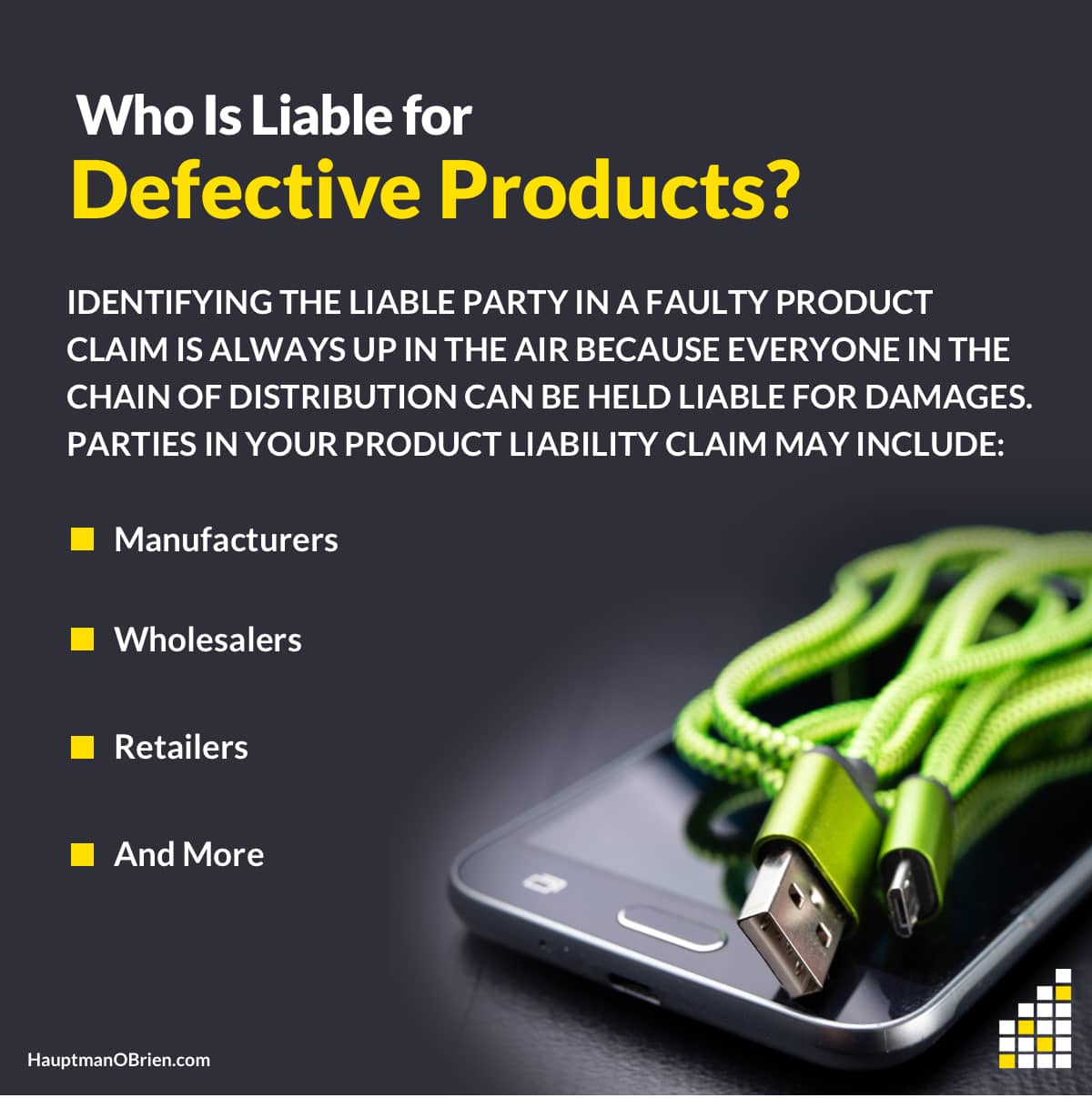
Identifying the liable party in a faulty product claim is always up in the air because everyone in the chain of distribution can be held liable for damages.
How Our Omaha Attorneys Prove Liability in Defective Product Cases
At Hauptman, O’Brien, Wolf & Lathrop, LLC, we conduct a thorough investigation to determine how the product failed and who should be held responsible. Building a strong product liability claim often involves gathering technical evidence and working with industry experts.
Depending on the circumstances, we may:
- Preserve and inspect the defective product before it is altered or destroyed.
- Review design specifications, manufacturing records, and quality control documents.
- Obtain maintenance records, recalls, and prior incident reports involving the same product.
- Consult engineers, product safety experts, and other specialists to identify the defect.
- Demonstrate that the product was being used as intended or in a reasonably foreseeable manner.
- Establish that the defect directly caused your injuries and resulting financial losses.
Our goal is to build the strongest possible case so that manufacturers, distributors, retailers, or other responsible parties can be held accountable for the harm their defective product caused.
Steps to Take After Suffering an Injury Due to a Defective Product in Omaha
The actions you take after a defective product causes an injury can significantly affect your ability to pursue compensation.
After an accident, consider taking the following steps:
- Seek immediate medical attention and follow all treatment recommendations.
- Stop using the product immediately.
- Preserve the product in the same condition it was in after the incident.
- Keep all packaging, instruction manuals, warning labels, and receipts.
- Photograph the product, your injuries, and the accident scene.
- Avoid repairing, altering, or disposing of the defective product.
- Contact an experienced Omaha product liability lawyer as soon as possible.
There is a statute of limitations on many types of product liability claims. Claims often must be filed within a limited period after the injury occurs. Waiting too long may prevent you from recovering compensation.
Compensation for Defective Product Claims in Nebraska
The compensation you may be entitled to for a defective product injury will depend on the specific losses you and your family have sustained. The Omaha product liability attorneys at Hauptman, O’Brien, Wolf & Lathrop can fully account for the damages in your case and build a strong claim on your behalf. Common types of damages recoverable in product liability claims include:
- Current and future medical bills
- Lost wages
- Loss of earning capacity (future income) if you are unable to work long-term or permanently
- Expenses for medical-related travel, hiring professional service providers for home healthcare and household work, modifying your residence and vehicle, etc.
- Pain and suffering
- Emotional anguish
- Disability
- Scarring and disfigurement
You may also be entitled to compensation if your loved one was killed by a faulty product. Potential damages in a wrongful death claim include:
- Bills related to funeral services and burial or cremation
- Loss of the decedent’s income and other financial support
- Medical expenses for care provided prior to the death of a loved one
- Your loved one’s conscious pain and suffering prior to death
- Loss of consortium (the loss of affection, intimacy, and companionship between spouses, as well as the loss of household services the spouse provided before death)
- Loss of parental guidance (if the decedent had a child or children, they can recover for the loss of emotional support and nurturing)
Companies that design, make, distribute, and sell products are principally concerned about their bottom line. They are not in the business of fairly compensating consumers who get hurt using their products. Insurance carriers further complicate these matters, frequently offering minimal settlements and even disputing liability for injuries.
Our product liability attorneys can help you overcome these challenges. We know how businesses and insurers operate, and our lawyers draw upon more than 268 years of combined experience to develop strategies for recovering the compensation you and your loved ones deserve.
Speak with an Omaha Product Liability Attorney at Hauptman, O’Brien, Wolf & Lathrop, LLC Today
A serious injury caused by a defective product can leave you facing unexpected medical expenses, lost income, and uncertainty about what comes next. At Hauptman, O’Brien, Wolf & Lathrop, LLC, we are committed to protecting the rights of injured consumers throughout Omaha and Nebraska by pursuing the full compensation they deserve.
When you contact our firm, we will listen to your story, answer your questions, and provide an honest assessment of your case. If legal action is appropriate, we will represent you at no upfront cost, collecting a fee only if we recover compensation on your behalf. For your convenience, we also offer home, hospital, and nursing home visits. There are no attorney fees unless we win.
Have you sustained injuries due to a defective product? If you’re in Omaha, or anywhere in Nebraska, contact Hauptman, O’Brien, Wolf & Lathrop, LLC today for a free, no-obligation consultation. Call our Omaha office at (402) 241-5020 or reach out through our online contact form to discuss your legal options with an experienced Omaha product liability lawyer.
Product Liability FAQ
Can I Sue for a Defective Product?
Product liability is a complex area of law. At minimum, you must be able to prove (a) the product in question was defective, (b) your injuries were caused by the product defect, and (c) the product was not modified and you used it as intended. You do not have to own the product in question to file a product liability claim. For example, the manufacturer of a defective vehicle may be liable for injuries sustained by anyone involved in an accident caused by the faulty part – including pedestrians, other motorists, etc.
Vehicle defects may be a factor in claims involving:
- Car accidents
- Truck accidents
- Motorcycle accidents
- Boat accidents
- Aircraft accidents
Similarly, if you are injured at work due to a faulty product (such as defective tools, equipment, etc.), you may have a claim against the manufacturer and other liable parties. These claims fall outside the workers’ compensation system, and injured employees can recover significantly more in damages.
You are not automatically entitled to compensation for injuries caused by a defective product. The evidence must support your claim that the product was defective and your injuries occurred as a result. Issues such as negligence and breach of warranty may also be involved.
For all of these reasons, it is in your best interest to contact Hauptman, O’Brien, Wolf & Lathrop as soon as possible if you believe you or a loved one was harmed by a defective product. Our product liability lawyers can advise you of your options for recovering compensation, represent you in negotiations with the liable parties and their insurance companies, and take your case to trial if necessary.
How Do You Prove a Product Is Defective?
Consumers are often unaware that a product they use is defective. When the product fails, it is not uncommon to think that “user error” may have been the issue. In reality, however, most product defects arise due to errors on the part of manufacturers, distributors, and other parties in the chain of commerce. With this in mind, it is important to consult an attorney as soon as possible to determine if you have a product liability claim.
Expert analysis is crucial for determining whether a product is defective. Our lawyers consult with engineering and industrial experts who examine the product for faulty designs, manufacturing errors, and other issues that made the product dangerous.
Other key aspects of building a defective product claim include:
- Assessing your use of the product at the time of the accident
- Determining how your injury or injuries occurred
- Calculating the damages you have sustained
The attorneys at Hauptman, O’Brien, Wolf & Lathrop will fully evaluate your medical records to understand the nature and extent of your injuries. We also investigate the total economic and non-economic impact to ensure that your product liability claim accounts for all damages.
How Long Do I Have to Bring a Product Liability Claim?
All injury claims are subject to a time limit known as the statute of limitations. In Nebraska, product liability claims involving injury must be filed within four years. If the product defect results in the death of a loved one, however, you and your family only have two years to bring a claim. Wrongful death claims are subject to a shorter statute of limitations than personal injury cases.
Is Product Liability Strict Liability?
Many product liability claims are tried under the legal theory of strict liability. In a strict liability claim, you do not have to prove negligence on the part of a manufacturer, distributor, and/or other parties to recover compensation. The most common defense manufacturers and other parties use to counter strict liability claims is to argue that the consumer misused or modified the product, and his or her injuries occurred as a result. However, the Nebraska Supreme Court has excluded the comparative negligence defense in strict liability claims. Therefore, defendants in product liability cases in Nebraska cannot cite misuse or modification of a product on the part of a consumer to dispute claims of strict liability for product-related injuries.
It is important to note that comparative negligence laws may apply in cases brought on the grounds of negligence, breach of warranty, etc. Damages awarded to plaintiffs in these product liability claims may be reduced according to the proportion of fault if the defense is successful in arguing that the consumer’s negligence contributed to the failure of the product.
What Should I Do with a Defective Product?
If a product you own breaks or stops working, your first impulse is likely to throw it away or return it to the store for a refund. You may also receive recall notices for products with known defects. Your health and safety and the health and safety of your family is your top priority. However, if you or someone you love has been harmed by a defective product, you must keep the product in your possession.
If you return the product or throw it away, you are effectively discarding the key piece of evidence in your case. You should keep the product in a safe place where no one can access it. Our attorneys can take the product for you and perform an expert inspection to determine if you have a case.
Additional steps you should take include:
- Gathering receipts that show where and when you bought the product
- Locating instruction manuals and packaging for the product
- Collecting product warranty information
During your free consultation, the product liability attorneys at Hauptman, O’Brien, Wolf & Lathrop will review these and other materials. Our team will investigate thoroughly to identify all liable parties in your case and develop a strategy to pursue compensation on your behalf.


