



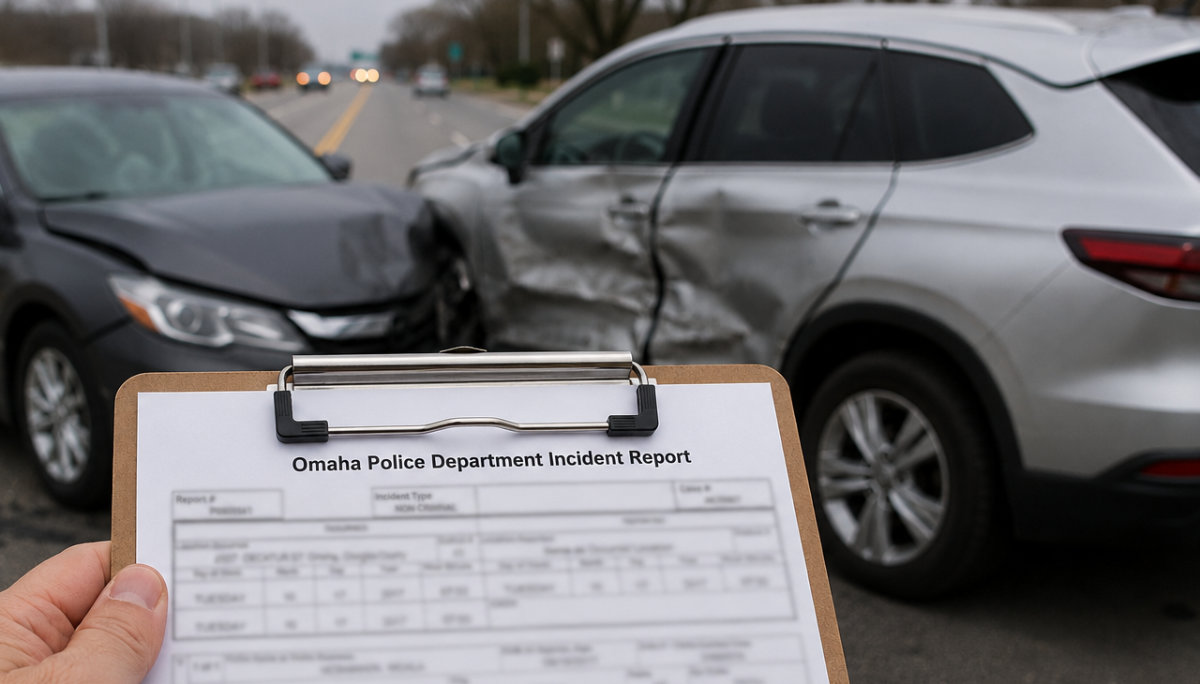
When a police officer prepares an accident report, many people assume the document is final and cannot be questioned. That is a common misconception. While police reports often play an important role in insurance claims and personal injury cases, they are not infallible. Officers work under difficult conditions, interview witnesses with varying recollections, and sometimes prepare reports before every piece of evidence is available. As a result, mistakes and omissions can happen.
If you believe a police report contains inaccurate information after a car accident or another injury-causing incident, you may have options. Understanding what a police report is, how it is used in Nebraska, and the proper way to address errors can help protect your legal rights. In many situations, experienced legal guidance can make a meaningful difference in the outcome of your claim.
Injured in a Nebraska vehicle accident? If you think the accident report is incomplete or wrongful, call our Omaha car accident lawyers at (402) 241-5020 or contact us online for a free consultation.
What Role Does a Police Report Play in a Nebraska Personal Injury Case?
A police report serves as an official record of an accident or incident. In Nebraska motor vehicle crashes involving injury, death, or certain levels of property damage, law enforcement officers typically investigate the scene and prepare a report documenting what they observed.
Although insurance companies often rely heavily on these reports during their investigations, a police report does not determine legal liability by itself. Nebraska courts consider many different forms of evidence before deciding who was responsible for an accident.
A police report may include:
- Officer observations: Road conditions, vehicle damage, weather, and other details documented at the scene.
- Statements from drivers and witnesses: Initial accounts of how the incident occurred.
- Diagrams and measurements: Information showing vehicle positions, skid marks, traffic controls, or points of impact.
- Traffic citations: Whether an officer issued a citation for an apparent traffic violation.
For example, an officer may conclude that one driver failed to yield based on the information available at the scene. Later, surveillance footage from a nearby business or additional witness testimony may present a more complete picture. That is one reason police reports should be viewed as valuable evidence rather than the final word.
Can You Challenge a Police Report?
Yes. In many cases, you can challenge factual inaccuracies or incomplete information contained in a police report. However, the process depends on the type of error and the circumstances surrounding the accident.
Some errors are relatively straightforward to address. Others require substantial supporting evidence before an insurance company or court will reconsider the facts.
Common issues include:
- Incorrect personal information: Misspelled names, wrong insurance information, or incorrect vehicle descriptions.
- Missing witnesses: Individuals who saw the accident but were never interviewed.
- Incomplete facts: Important roadway conditions or vehicle damage omitted from the report.
- Incorrect diagrams: Vehicle positions or directions shown inaccurately.
- Questionable conclusions: Fault determinations based on incomplete evidence.
Simply disagreeing with the officer’s opinion is usually not enough. Instead, the challenge should be supported by objective evidence that demonstrates why the report should be reconsidered.
In Nebraska, the police report itself is often only one piece of evidence considered during settlement negotiations or litigation. Additional documentation may ultimately carry greater weight than the officer’s initial conclusions.
What Evidence Can Help Correct an Inaccurate Police Report?
Strong evidence is the foundation of any successful challenge. The sooner that evidence is gathered after an accident, the more useful it typically becomes.
Evidence that may support your position includes:
- Photographs and videos: Images of vehicle damage, skid marks, debris, traffic signals, weather conditions, and roadway layouts.
- Witness statements: Independent witnesses often provide valuable perspectives that differ from those of the involved drivers.
- Dash camera footage: Increasingly common evidence that captures events immediately before and during a collision.
- Surveillance videos: Nearby businesses, homes, or traffic cameras may have recorded the incident.
- Medical records: Documentation that supports the severity and timing of your injuries.
- Accident reconstruction analysis: In complex cases, engineering experts may analyze physical evidence to determine how the collision occurred.
Imagine a crash at a busy Omaha intersection where an officer believes Driver A ran a red light. Later, traffic camera footage clearly shows Driver B entering the intersection after making an illegal turn. That new evidence could substantially affect insurance negotiations and any resulting personal injury lawsuit.
Nebraska follows a modified comparative negligence system under Neb. Rev. Stat. § 25-21,185.09. If fault is disputed, even a relatively small correction to the facts may significantly influence the compensation available to an injured person.
How Can You Request Changes to a Police Report?
The process depends on the nature of the mistake and the law enforcement agency that prepared the report.
Minor clerical errors, such as incorrect addresses or vehicle identification numbers, may sometimes be corrected by contacting the investigating agency directly. More significant disagreements involving accident causation or fault generally require additional documentation rather than a simple correction request.
If you believe the report is inaccurate, consider the following steps:
- Review the report carefully: Identify every factual error rather than relying on memory alone.
- Gather supporting evidence: Collect photographs, videos, witness information, and other relevant documents.
- Contact the investigating agency: Ask whether supplemental information can be submitted.
- Keep detailed records: Maintain copies of every communication regarding the report.
- Speak with a personal injury attorney: Legal counsel can evaluate whether additional investigative steps are appropriate.
Even if the report itself is never formally changed, supplemental evidence can still become part of your insurance claim or court case. In many situations, insurers eventually place greater emphasis on the complete body of evidence than on the original report alone.
How Can an Incorrect Police Report Affect Your Insurance Claim?
Insurance companies frequently begin their investigations by reviewing the police report. An inaccurate report may initially influence how adjusters evaluate liability, injuries, or settlement value.
That does not necessarily mean the outcome is predetermined.
Insurance investigations typically involve reviewing multiple sources of evidence, including medical records, photographs, repair estimates, recorded statements, and expert opinions. If inconsistencies appear, adjusters often conduct further investigation before making final decisions.
An inaccurate report can potentially lead to:
- Delayed claim processing: Additional investigation may become necessary.
- Lower settlement offers: Insurers may initially dispute liability or damages.
- Greater disputes over fault: Particularly when multiple drivers contributed to the collision.
- Additional litigation: Some disagreements ultimately require resolution in court.
Nebraska’s modified comparative negligence law makes accurate fault determinations especially important. Under state law, an injured party generally cannot recover damages if they are found to be 50 percent or more responsible for the accident. Even percentages below that threshold reduce compensation proportionally. Because of this, correcting factual misunderstandings early may have a meaningful financial impact.
When Should You Contact a Personal Injury Attorney?
Not every police report error requires legal intervention. However, when serious injuries, disputed liability, or substantial insurance claims are involved, experienced legal representation can help protect your interests.
Our attorneys regularly investigate motor vehicle accidents beyond what appears in the initial police report. We obtain additional evidence, interview witnesses, work with accident reconstruction experts when appropriate, and challenge unsupported conclusions presented by insurance companies.
A personal injury attorney may be able to help by:
- Conducting an independent investigation: Looking beyond the original police report.
- Preserving important evidence: Preventing surveillance footage or electronic records from being lost.
- Communicating with insurers: Presenting evidence that supports your claim.
- Working with qualified experts: Building stronger liability and damages arguments.
- Representing you in court: If negotiations fail to produce a fair resolution.
Many people hesitate to seek legal advice because they assume the police report has already decided the outcome. In reality, experienced attorneys often uncover evidence that significantly changes how a case develops.
Believe a Police Report Is Wrong? Contact Hauptman, O’Brien, Wolf & Lathrop Today
If you believe a police report contains mistakes that could affect your injury claim, you do not have to accept those errors without question. At Hauptman, O’Brien, Wolf & Lathrop, LLC, we know how insurance companies evaluate accident reports, and we understand how additional evidence can change the direction of a case. With over 268 years of combined legal experience, we proudly represent injured clients throughout Nebraska from our offices in Omaha, South Omaha, Bellevue, and Lincoln.
Our team can review your accident report, investigate the facts, and determine whether inaccuracies may be affecting your claim. We will explain your legal options, gather supporting evidence, and work to protect your rights every step of the way.
If you have questions about a police report or your personal injury claim, contact Hauptman, O’Brien, Wolf & Lathrop today for a free consultation, or call us at (402) 241-5020.


