




The human brain is incredibly complex. It is made of many delicate parts, which together create an intricate command center for the entire body. Any damage can fundamentally and even permanently alter one’s quality of life. Brain injuries are devastating, life-changing events. They turn lives upside down — often in mere moments.
At Hauptman, O’Brien, Wolf & Lathrop, our brain injury lawyers take these claims very seriously. We know how overwhelming their impact can be. It is our mission to ensure no family has to endure this terrible burden alone.
We serve clients in Omaha and throughout Nebraska. If you or a loved one has sustained a brain injury due to someone else’s negligence, call us today at (402) 241-5020 or contact us online for a free consultation.
What Our Omaha Brain Injury Attorneys Can Do for You
A traumatic brain injury can affect every aspect of your life, from your health and finances to your future independence. Our Omaha brain injury attorneys have the experience and resources to help you pursue the compensation you need to move forward.
- We will investigate the cause of your brain injury and gather the evidence needed to identify every individual, business, or entity responsible for your losses.
- We will work with medical experts and specialists to understand the full extent of your brain injury and document its long-term impact on your health and daily life.
- We will handle all the paperwork related to your brain injury case, including insurance forms, legal filings, medical documentation, and other required records, helping keep your claim organized and on track.
- We will calculate the full value of your damages, including medical expenses, rehabilitation costs, lost income, diminished earning capacity, and pain and suffering.
- We will handle all communications and negotiations with insurance companies to protect your rights and pursue a settlement that reflects the true value of your claim.
- We will prepare your case for trial if necessary and advocate aggressively in court when a fair settlement cannot be reached through negotiation.
Brain injury cases often require extensive investigation and careful preparation. Our legal team is committed to building the strongest case possible on your behalf.
Whether through settlement or trial, we will work tirelessly to pursue the financial recovery you need while allowing you to focus on your treatment and recovery.
Compensation for Brain Injury Victims
Brain injuries can range in severity – from bumps and bruises to severe concussions and brain swelling. If serious enough, brain injuries can lead to memory loss, cognitive disabilities, and major shifts in behaviors that can change one’s standard of living.
If you have been in an accident and have suffered a brain injury, you need to consider hiring an experienced brain injury lawyer to represent your legal rights. Our personal injury lawyers will gather what is necessary to move forward in pursuing compensation for your brain injury. We will work tirelessly to prove negligence in your case and pursue damages from the at-fault party. Damages that we pursue could include but are not limited to:
Special Damages
These are economic damages that you may need compensation for in your case. These may include:
- Lost wages due to missing work.
- Loss of earning capacity due to your injury.
- Your medical expenses.
- Funeral and burial expenses in a wrongful death case.
- Property damages due to your accident.
General Damages
These damages are non-economic losses that include:
- Pain and suffering
- Humiliation
- Mental anguish
- Loss of companionship
- Emotional distress
- PTSD
The circumstances of your accident will determine what types of damages you may be compensated for. Our personal injury lawyers will work to get you the compensation you deserve for all of the damages that you incur in your accident.

Common Causes of Brain Injuries in Nebraska
More than two million people suffer some form of brain injury every single year. Many of these are traumatic and are accompanied by severe or permanent disabilities. Others are less ominous but may require extensive treatment or hospitalization.
The most common causes of brain injuries in Nebraska include:
- Automobile accidents
- Motorcycle accidents
- Bicycle accidents
- Trucking accidents
- Sports accidents
- Assault and Battery
- Other violent crimes
- Stroke
- Slip and fall (or other types of falls)
- Swimming pool accidents, including diving board accidents
- Construction site injuries
- Unsafe working conditions
- Unsafe premises (e.g., public or commercial property)
- Medical malpractice
- Birth injury
The brain is a vulnerable organ, but it is well protected by the skull. It is rare for the brain to sustain an injury in the ordinary course of life. In the majority of brain injury cases, someone else’s careless, reckless, or dangerous behavior is to blame.
The responsible parties are likely represented by insurance companies or attorneys who will do everything to avoid paying what you’re owed. You need an experienced and effective legal representative to fight for your rights.
At Hauptman, O’Brien, Wolf & Lathrop, we understand just how multifaceted brain injury claims can be. Because the brain is involved in literally every aspect of your life, the span of your suffering may be quite extensive.
How Is a Brain Injury Diagnosed?
If you have symptoms of a brain injury after an accident, you should see a doctor immediately so that you can receive a medical diagnosis. Once it is established that you have a brain injury, you can then start treatment and begin on the road to recovery.
The main tests that are used for diagnosing head injuries include:
- X-rays – For instances of a broken or fractured skull, doctors will be able to quickly identify them with the help of an x-ray machine. While x-ray machines are effective for revealing skull injuries, they are not effective for revealing issues with muscle or tissue.
- CT scan (Computed Tomography) – Also, know as a CAT scan, a CT scan generates a two-dimensional image “slice” of the human brain to reveal damaged and healthy areas.
- MRI scan (Magnetic Resonance Imaging) – An MRI scan uses magnetic fields and radio waves to produce detailed images of the human brain. An MRI will typically be used for showing deep brain structural issues. To provide contrast, a medical professional will often inject dye through an IV before the scan to bring out more details in the images.
- Intracranial Pressure Monitor – This is a device that is placed inside the head to measure the pressure present inside of the victim’s skull. When a victim of a brain injury experiences swelling inside their skull, this test can be extremely effective in revealing procedures that could be done to stop the swelling.
Symptoms of Brain Injuries
Not all brain injuries are the same. Some are relatively mild, others potentially fatal. Some arise from cerebral bleeding or blunt force trauma, others from deprivation of oxygen or blood. Some are treatable; others inflict lifelong impairment or disability.
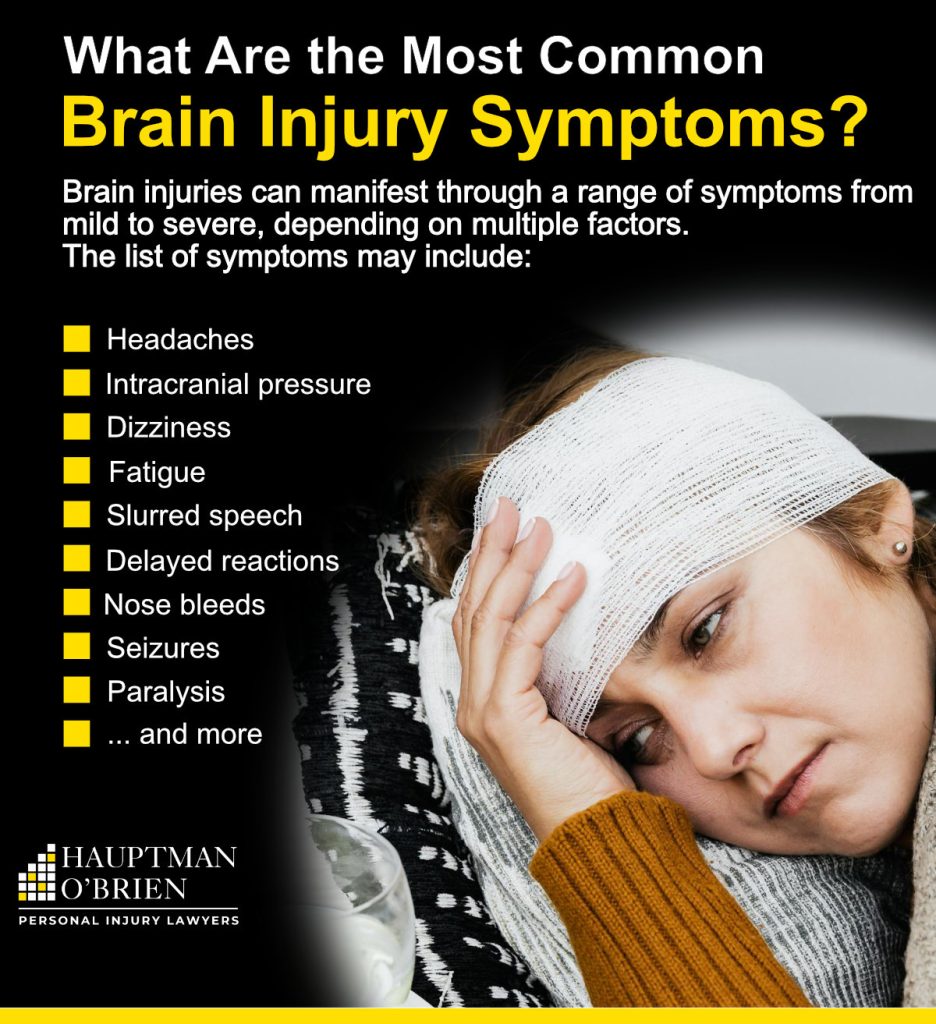
A concussion is the most common kind of brain injury. Unfortunately, there is a popular misconception that concussions are not very serious. On the contrary, they are officially classified as “traumatic” and can result in serious damage. While most concussions are temporary and treatable, there is a real risk for long-term or even permanent complications.
Symptoms of concussion (mild traumatic brain injury) include:
- A headache or pressure in the head
- Temporary loss of consciousness (30 seconds or less)
- Memory loss / amnesia
- Confusion / fogginess
- Dizziness
- “Seeing stars”
- Nausea
- Vomiting
- Ringing in the ears (tinnitus)
- Delayed responses
- Slurred speech
- Fatigue
- Irritability & personality changes
- Difficulty concentrating
- Difficulty sleeping
- Sensitivity to light or sound
It is possible to sustain a concussion even without an obvious blow to the head. Vigorous motion or whiplash may be enough. The symptoms of concussion are often subtle, ambiguous, or slow to appear. Nevertheless, prompt treatment is essential. Please never dismiss symptoms without first seeking medical attention.
Serious Traumatic Brain Injury (TBI) Symptoms
A more serious TBI might cause any of the symptoms listed above for concussions, in addition to the following:
- Paralysis (partial or total)
- Unconsciousness lasting more than 30 seconds
- Seizures
- Coma
- Blindness (partial or total)
- Loss of other senses
- Convulsions
- Fractured skull
- Blood or discharge from ears, nose, or mouth
- Difficulty remaining conscious/awake
- Headaches that begins as mild but steadily grow worse
- Severe or repeated vomiting
- Changes in pupil size/dilation
- Speaking but not making sense
- Difficulty understanding what others are saying
- Stiff neck
- Loss of coordination
- Stumbling
- Large bumps on head
- Symptoms that worsen over time
All of these symptoms warrant immediate, emergency medical attention. Call 911 right away. If you or a loved one has been the victim of an accident that caused a brain or spinal cord injury, contact the Omaha brain injury lawyers at Hauptman, O’Brien, Wolf & Lathrop, P.C.
Maximize Your Recovery – Get Legal Help for Your Brain Injury Today!
If you or a loved one has suffered a brain injury because of someone else’s negligence, an Omaha brain injury attorney at Hauptman, O’Brien, Wolf & Lathrop, LLC can help. With more than 268 years of combined experience, we pursue compensation for medical expenses, lost income, rehabilitation costs, pain and suffering, and other losses. We work closely with trusted medical experts to fully document your injuries and strengthen your claim during settlement negotiations or at trial. We handle brain injury cases on a contingency fee basis, so you pay no attorney’s fees unless we recover compensation for you.
Call us today at (402) 241-5020 or contact us online for a free consultation, so we can begin working on building you a strong case and secure the compensation you deserve.
Frequently Asked Questions About Brain Injury Claims
How Do I Know If I Have a Valid Brain Injury Claim?
Not every accident automatically leads to a valid legal claim, even if you have been diagnosed with a brain injury. The key issue is whether someone else’s negligence caused or contributed to your injury.
Our legal team evaluates the details of your situation, including how the accident occurred and what evidence is available. We take the time to listen to your story, review medical documentation, and determine whether there is a strong legal basis to pursue compensation on your behalf.
What If My Brain Injury Symptoms Appeared Days or Weeks Later?
It is not uncommon for brain injury symptoms to develop gradually rather than immediately after an accident. Many clients come to us concerned that delayed symptoms may hurt their case. In reality, delayed onset is medically recognized, especially with concussions and TBIs.
Our lawyers at Hauptman, O’Brien, Wolf & Lathrop work closely with medical professionals to connect your symptoms to the original incident. The most important step is seeking medical attention as soon as you notice changes, so your condition is properly documented.
How Can a Brain Injury Affect My Ability to Work Long-Term?
A brain injury can have a lasting impact on your career, even if you initially return to work. Some clients experience reduced concentration, memory issues, or difficulty handling stress, all of which can limit earning potential over time.
We take these long-term effects seriously and factor them into your claim. Our team evaluates:
- Whether you can return to your previous job or role
- If retraining or career changes are necessary
- The long-term impact on your earning capacity
This allows us to pursue compensation that reflects your future, not just your immediate losses.
What Should I Avoid Doing After Suffering a Brain Injury?
Certain actions can unintentionally weaken your legal claim or delay your recovery. We often advise clients to be cautious in the days and weeks following an injury.
At Hauptman, O’Brien, Wolf & Lathrop, we typically recommend that you avoid:
- Ignoring medical advice or skipping follow-up appointments
- Posting details about your accident or condition on social media
- Speaking with insurance adjusters before getting legal guidance
- Downplaying your symptoms or returning to strenuous activity too soon
Taking the right steps early on can protect both your health and your case.
How Long Do I Have to File a Brain Injury Lawsuit in Nebraska?
In Nebraska, brain injury claims are generally subject to a statute of limitations, which typically gives you four years from the date of the injury to file a lawsuit. However, certain circumstances can affect this timeline, such as cases involving minors or delayed discovery of the injury.
Our lawyers strongly encourage acting sooner rather than later; early action helps preserve evidence and strengthens your claim. We can review your situation and ensure all deadlines are properly met so your rights remain fully protected.


