



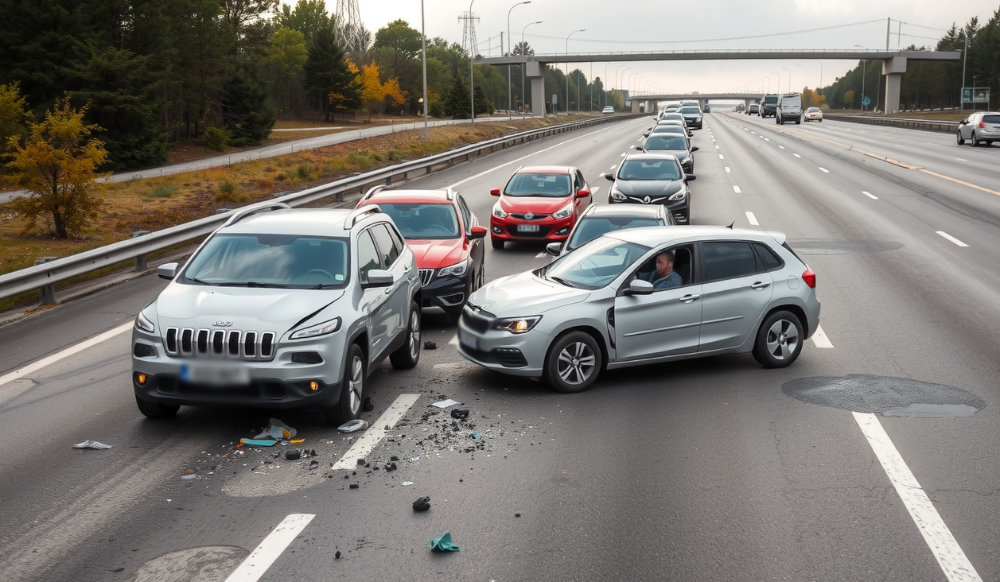
Determining fault after a two-car collision can be challenging. When three, four, or even more vehicles are involved, establishing responsibility can become significantly more complicated. One driver’s mistake may trigger the initial impact, while the actions of other motorists can contribute to subsequent collisions and injuries.
If you’ve been unfortunate enough to be part of a Nebraska multi-car pile-up, investigators may need to reconstruct the sequence of impacts, examine all the evidence and what each driver was doing immediately before the crash, and determine whether several parties share responsibility. Establishing fault matters because Nebraska’s comparative negligence rules can directly affect an injured person’s ability to recover compensation.
At Hauptman, O’Brien, Wolf & Lathrop, LLC, our Nebraska car accident attorneys investigate complex motor vehicle accidents and help injured people understand their legal options. Below, we explain how multi-car crashes happen, how fault may be divided, and what evidence can help establish liability. If you were injured in a multiple-vehicle collision, call (402) 241-5020 or contact us online for a free consultation.
How Multiple Car Accidents Typically Happen in Nebraska
A multiple-car accident can begin with a single collision that sets off a chain reaction. For example, one motorist may suddenly brake for an obstacle, causing a following driver to rear-end that vehicle. The force of the collision could then push one or both vehicles into additional traffic.
Other multi-car crashes may involve several drivers making separate mistakes within seconds of one another. Common contributing factors include:
- Following too closely
- Speeding or driving too fast for road conditions
- Distracted driving
- Unsafe lane changes
- Failure to yield
- Impaired driving
- Drowsy or fatigued driving
- Poor visibility
- Rain, snow, ice, or other dangerous road conditions
- Vehicle or mechanical defects
Pile-ups can be particularly serious on highways, where vehicles are traveling at higher speeds and approaching drivers may have little time to react to a collision blocking the roadway.
Who Is Usually at Fault in Nebraska Multi-Car Pile-Ups?
Fault in a Nebraska multi-car pile-up is not automatically assigned to the driver who caused the first impact. Investigators must examine the entire sequence of events to determine whether one or several parties contributed to the crash.
Depending on the circumstances, potentially at-fault parties may include:
- Distracted drivers: A motorist texting, using a phone, or otherwise not paying attention may fail to notice slowing or stopped traffic.
- Aggressive or reckless drivers: Speeding, tailgating, weaving between lanes, or making unsafe maneuvers can trigger or worsen a multi-vehicle collision.
- Impaired drivers: Alcohol or drugs can affect judgment, reaction time, and a driver’s ability to avoid a developing crash.
- Commercial drivers and their employers: Trucking companies and other employers may share liability when an employee causes a collision while performing work-related duties.
- Vehicle manufacturers or repair shops: Defective components or negligent repairs may contribute to a loss of vehicle control.
- Municipalities or other government entities: Dangerous road defects, inadequate maintenance, or other roadway hazards may contribute to a pile-up.
Because several parties can share responsibility, determining fault requires examining what each potentially liable party did, or failed to do, before and during the crash.
Key Factors Investigators and Accident Reconstructionists Consider
After several vehicles collide, simply looking at where they came to rest may not reveal how the accident began. Investigators need to work backward to determine the sequence of events.
Police officers, attorneys, insurance investigators, and accident reconstruction experts may consider factors such as:
- The location and severity of damage to each vehicle
- Skid marks, tire marks, and debris patterns
- The location where each vehicle came to rest
- Vehicle speeds before and during the collision
- Braking and steering actions
- Traffic signals and signs
- Road design and conditions
- Weather and visibility
- Statements from drivers and eyewitnesses
- Surveillance, dashcam, or traffic-camera footage
- Vehicle event data recorder information
- Cellphone records when distracted driving is suspected
Accident reconstructionists can use scientific principles, forensic analysis, vehicle damage, scene measurements, and computer modeling to recreate a crash. Their findings may help establish which collision occurred first and how each driver’s actions contributed to subsequent impacts.
Nebraska’s Comparative Fault
Nebraska follows a modified comparative negligence system. This becomes especially important in multiple-car accidents because responsibility may be divided among several people.
Under Nebraska law, an injured person’s own negligence does not necessarily prevent recovery. However, the person’s compensation can be reduced according to his or her percentage of fault. If the injured person’s negligence is equal to or greater than the combined negligence of the parties from whom recovery is sought, recovery is barred.
This makes an accurate investigation particularly important. Even a relatively small change in the percentage of fault assigned to a person can significantly affect the amount of compensation available.
How Do Fault Percentages Matter?
Consider a hypothetical four-vehicle pile-up involving Drivers A, B, C, and D. After reviewing the evidence, assume responsibility is allocated as follows:
- Driver A: 45 percent – Was speeding and caused the initial collision
- Driver B: 30 percent – Was following too closely and could not stop
- Driver C: 20 percent – Made an unsafe lane change during the developing crash
- Driver D: 5 percent – Was distracted and reacted later than a reasonably careful driver would have
Suppose Driver D suffers $100,000 in compensable damages. Because Driver D was 5 percent at fault, that percentage could reduce the available recovery by $5,000. Drivers A, B, and C collectively account for the remaining 95 percent of the fault, although how liability for damages is ultimately allocated among them depends on Nebraska law and the circumstances of the case.
The example demonstrates why identifying every driver who contributed to a multi-car accident is important. Rather than focusing only on the person who triggered the first collision, investigators may examine the conduct of Drivers A, B, and C, and any other potentially responsible parties, to determine how each contributed to Driver D’s injuries and losses.
Involvement of Commercial Vehicles or Government Vehicles
When a commercial vehicle is involved, the driver may not be the only potentially responsible party. An employer or motor carrier could also face liability depending on the driver’s employment, maintenance practices, training, supervision, or other circumstances surrounding the collision.
For example, an investigation may examine whether a commercial driver was fatigued, whether the vehicle was properly maintained, and whether applicable safety requirements were followed. Maintenance companies or manufacturers could potentially enter the case if defective equipment or improper repairs contributed to the accident.
Crashes involving government vehicles can present additional legal complications. Claims against Nebraska state or local government entities are governed by special statutes and procedures that differ from ordinary personal injury claims. Nebraska’s Political Subdivisions Tort Claims Act, for example, contains specific written-claim requirements, while claims against the State of Nebraska are subject to the State Tort Claims Act. Because special requirements and deadlines can apply, seeking legal advice promptly can be particularly important in these cases.
Evidence That Matters Most in Establishing Liability in a Nebraska Multi-Car Pile-Up
Strong evidence is essential when several drivers and insurance companies disagree about what happened. Some evidence can also disappear quickly, making a prompt investigation important.
A police accident report can provide a useful starting point. Depending on the accident, it may document the date, time, and location of the collision; information about the vehicles and drivers; injuries and property damage; witness information; and weather or road conditions.
Other important evidence may include:
- Photographs and videos of the accident scene
- Photos showing damage to each vehicle
- Eyewitness statements
- Surveillance and traffic-camera footage
- Dashcam recordings
- Event data recorder or other electronic vehicle data
- Cellphone records
- Vehicle inspection and maintenance records
- Medical records and bills
- Repair estimates
- Proof of lost income
- Communications with insurance companies
- Testimony from accident reconstructionists and other experts
Evidence should establish more than simply that a crash occurred. It can help show the sequence of impacts, what each driver did or failed to do, and whether those actions contributed to the claimant’s injuries.
How Our Attorneys Work on Establishing Liability in a Nebraska Multiple-Car Accident
At Hauptman, O’Brien, Wolf & Lathrop, LLC, our attorneys can take steps such as:
- Investigating the accident: We review police reports, photos, videos, witness statements, and other available evidence.
- Obtaining additional evidence: We seek surveillance footage, vehicle data, maintenance records, and other relevant documentation.
- Working with accident reconstructionists: Experts can analyze vehicle damage, impact points, roadway evidence, and the collision sequence.
- Identifying liable parties: We investigate drivers, employers, motor carriers, manufacturers, maintenance providers, and government entities.
- Evaluating fault percentages: We assess how each party’s actions contributed to the accident and resulting injuries.
- Pursuing compensation: We seek compensation from responsible parties and their insurers based on the available evidence.
Every multi-car accident presents different circumstances, so establishing liability requires a careful review of the evidence. Our attorneys can handle this process while you focus on recovering from your injuries.
Protect Your Rights After a Nebraska Multi-Car Accident
Multiple-car crashes can produce conflicting accounts of what happened, and every driver and insurance company may have a different version of events. Acting promptly can help preserve photographs, video footage, electronic vehicle information, witness testimony, and other evidence needed to reconstruct the collision and establish each party’s responsibility.
If you or a loved one was injured in a multi-car accident, Hauptman, O’Brien, Wolf & Lathrop, LLC can review your case and explain your options during a free consultation. We handle personal injury cases on a contingency-fee basis, meaning you do not pay attorney fees unless we obtain compensation for you. Call (402) 241-5020 today to discuss your Nebraska multiple-car accident claim.


