



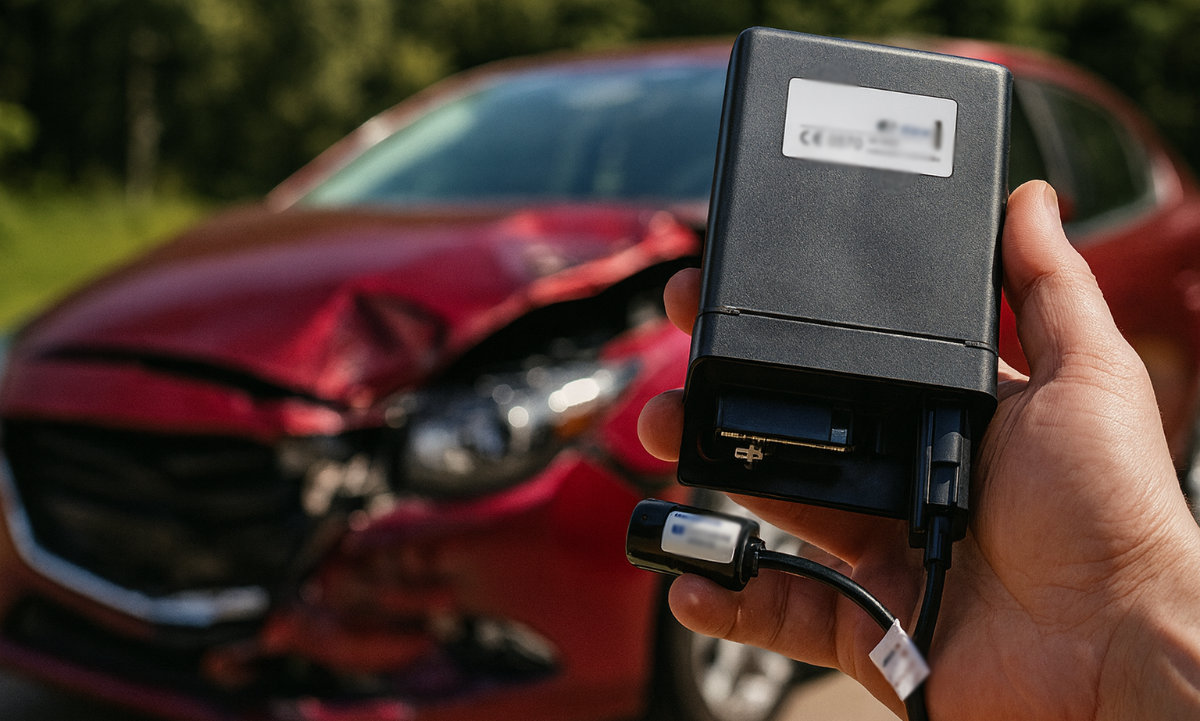
Modern cars are filled with computers quietly working in the background. Most drivers never think about them until something goes wrong. When a serious crash happens, one of those devices can suddenly become critically important: the crash data recorder, also known as an event data recorder or EDR.
For injured drivers and passengers in Nebraska and Iowa, EDR information can help answer key questions about how a collision happened and who should be held responsible. At Hauptman O’Brien, we regularly work with this digital evidence to support our clients’ claims and make sure the story told by the other driver or the insurance company is not the only version on the record. That’s why we’re going to break down here the importance of crash data recorders in car accidents and the data they record.
What Is an Event Data Recorder?
An event data recorder is a device in your vehicle that captures technical information in the seconds before, during, and immediately after a crash. Federal regulations describe it as equipment that records time series data about vehicle dynamics and systems, not audio or video, and not a full-time tracking device.
Most EDRs are tied to the airbag control module. When a significant impact or certain changes in speed occur, the system saves a snapshot of information. That snapshot can show how quickly the vehicle was moving, whether the brakes were used, and other details that are often fiercely disputed after a serious wreck. This is why EDRs are sometimes called a car’s “black box.”
Typical data points can include:
- Vehicle speed and changes in speed just before impact
- Brake use, throttle position, and steering inputs
- Seat belt status and airbag deployment timing
- Engine RPM and stability control activity
- The severity and direction of the crash forces
This kind of information does not replace witness statements or photographs, but it can strongly support or contradict them.
Which Vehicles Have EDRs?
There is no absolute federal requirement that every light vehicle be equipped with an EDR. Instead, federal rules in 49 C.F.R. Part 563 set standards for any vehicle that has one, including what must be recorded and how the data can be retrieved.
In reality, manufacturers have voluntarily installed EDRs in the vast majority of passenger cars and light trucks for many years. By the early 2010s, estimates suggested over 85 to 95 percent of new vehicles included some form of EDR technology.
If you drive a relatively modern vehicle, there is a good chance it has an EDR even if you have never seen it or heard about it. The device is usually buried deep inside the vehicle and requires specialized tools to access.
How EDR Data Influences Fault and Liability
In an accident case, one of the central questions is who was at fault and whether they were acting reasonably under the circumstances. Traditional evidence like witness statements and the police report can be helpful, but memories fade and people see events differently. EDR data provides an objective layer of information that can support or challenge those accounts.
For example, if another driver insists they were traveling at the speed limit but the crash data recorder shows their car was moving much faster, that discrepancy can be powerful evidence of negligence. Similarly, when someone claims they slammed on the brakes, EDR data can confirm whether the brake pedal was actually pressed before impact.
Attorneys and crash reconstruction experts may use EDR data to:
- Confirm or refute speeding allegations
- Show whether a driver tried to avoid the collision or never reacted
- Analyze seat belt use and airbag deployment in serious injury cases
- Reconstruct chain reaction crashes involving multiple vehicles
- Test competing explanations about how the collision began
Used correctly, EDR information helps build a clear timeline of what really happened. That clarity often influences how insurance companies evaluate responsibility and how juries view the credibility of each driver.
Accessing and Preserving EDR Data After a Crash
One of the biggest challenges with crash data recorders is timing. EDR data can be lost if a vehicle is repaired, destroyed, or involved in another event that causes the system to overwrite prior information. For that reason, preservation is critical.
After a serious collision, your legal team may send letters to the other driver, their insurer, or a storage facility requiring them to preserve the vehicle and its electronic data. In some cases, a court order is needed to ensure the car is not altered before experts can inspect it. Specialized tools, often made available by manufacturers under federal rules, are then used to download the EDR contents in a forensically sound way.
Key steps in preserving EDR evidence may include:
- Identifying which vehicles involved in the crash have compatible EDRs
- Notifying all parties in writing to avoid repairs or destruction without notice
- Arranging secure storage of the vehicles when possible
- Hiring qualified experts to perform the data download and interpretation
- Documenting the chain of custody so the data can be used in court
If this process is delayed, important information may be lost forever. That is one reason it can be helpful to speak with an attorney soon after a serious crash instead of waiting until months have passed.
Crash Data, Privacy, and Who Owns the Information
As vehicles collect more information, questions naturally arise about who owns that data and who has the right to see it. Federal law now provides some clear answers for EDR information. The Driver Privacy Act of 2015 states that data recorded by an event data recorder is the property of the vehicle’s owner, or in a lease situation, the lessee.
Under that law, EDR data generally cannot be accessed by others unless one of a few conditions is met, such as:
- The owner or lessee gives written, electronic, or audio consent
- A court or similar authority issues an order allowing retrieval
- Federal safety investigators are acting under specific legal authority
- The data is needed to provide emergency medical treatment after a crash
- The data is used for traffic safety research with personal details removed
In addition to this federal protection, states across the country, including Nebraska and Iowa, are enacting broader consumer privacy laws that affect how businesses handle many kinds of personal data.
For accident victims, the important takeaway is that you have rights concerning how your EDR data is used. At the same time, carefully sharing that information in the context of a legal claim can significantly strengthen your case when handled properly.
Is It Legal to Turn Off an EDR?
Many people are surprised to learn that federal law does not currently require every passenger vehicle to have an EDR at all. The regulations in 49 C.F.R. Part 563 apply to vehicles that are equipped with EDRs and set standards for data collection, storage, and retrieval, but they do not mandate installation in every model.
As a result, there is no blanket federal rule that specifically forbids disabling an EDR function in a privately owned vehicle. However, that does not mean it is a good idea or risk-free. Interfering with factory-installed safety systems may violate manufacturer warranties or vehicle lease terms. In a fleet or employer-owned vehicle, tampering with an EDR could breach company policy or employment agreements.
More importantly, intentionally destroying or altering EDR data after a collision may be treated as spoliation of evidence. Courts can impose serious consequences when they believe a person or company has tried to hide or erase information relevant to a lawsuit. Those consequences can include monetary sanctions or instructions that allow a jury to presume the missing data would have been unfavorable to the party who destroyed it.
In short, while the law around disabling EDRs is complex and still developing, intentionally turning one off to avoid accountability is likely to create more legal risk, not less. If you have concerns about vehicle data and privacy, it is safer to discuss them with a knowledgeable attorney rather than experimenting under the hood.
How Crash Data Recorders Affect Settlement Negotiations and Trials
EDR evidence does not sit in a vacuum. It plays a role in the broader negotiation with insurance companies and, if necessary, in the courtroom. Insurers look closely at anything that can limit their exposure. When the objective data supports your description of the crash, it becomes much harder for them to dismiss your injuries or shift blame onto you.
For example, if you state that the other driver ran a red light and never braked, and the EDR data shows no braking effort and high speed at the moment of impact, that alignment can significantly strengthen your position. On the other hand, if an insurer tries to argue you were speeding or made a sudden unsafe maneuver, your own vehicle’s EDR data may show you were driving within normal limits.
In practical terms, crash data recorders can:
- Encourage fairer settlement offers by reducing room for speculation
- Narrow the issues in dispute, saving time and resources
- Provide persuasive visuals and charts when presented by experts at trial
- Help explain complex crash dynamics to judges and juries in plain language
- Undercut inaccurate or inconsistent testimony from the at-fault driver
A law firm that understands how to obtain, interpret, and present this evidence can often use it as a powerful tool in pursuing full and fair compensation.
Why You Need Legal Help to Use EDR Evidence Effectively
Crash data sounds straightforward, but the reality is highly technical. Different manufacturers record different sets of information, and interpreting that information correctly requires training and experience. Pulling the raw data is only step one. Turning it into a clear, compelling story is where legal and expert collaboration becomes essential.
At Hauptman O’Brien, our attorneys know how to integrate EDR evidence into a broader case strategy. That typically includes:
- Coordinating timely downloads of data from all involved vehicles
- Working with qualified reconstruction experts who know the technology
- Comparing EDR readings with physical evidence, photographs, and the police report
- Identifying inconsistencies between the data and the other driver’s version of events
- Presenting the information in ways that are accessible to non-technical audiences
Because our firm focuses on personal injury law and has many decades of combined experience, we also understand that clients are more than their data. We use EDR information to support your claim, but we never lose sight of the human impact of the crash: your pain, your recovery, and the changes in your daily life.
Contact a Car Accident Lawyer at Hauptman O’Brien Today
If you or someone you love has been seriously hurt in a car crash in Nebraska or Iowa, you should not have to untangle complex questions about crash data recorders and legal rights on your own. While the other side may already be analyzing EDR information, you deserve a team that is just as thorough and committed to protecting your interests.
Hauptman O’Brien serves clients from offices in Omaha, South Omaha, Bellevue, Lincoln, Sioux City, and Council Bluffs. Our car accident attorneys combine technical knowledge, legal skill, and genuine compassion for the people we represent. When you contact us, you speak directly with an attorney, not a call center. Your consultation is free, and you pay no attorney fees unless we obtain a recovery for you. If you want to understand how crash data recorders might influence your accident case, reach out today and let our team start working on your behalf.


